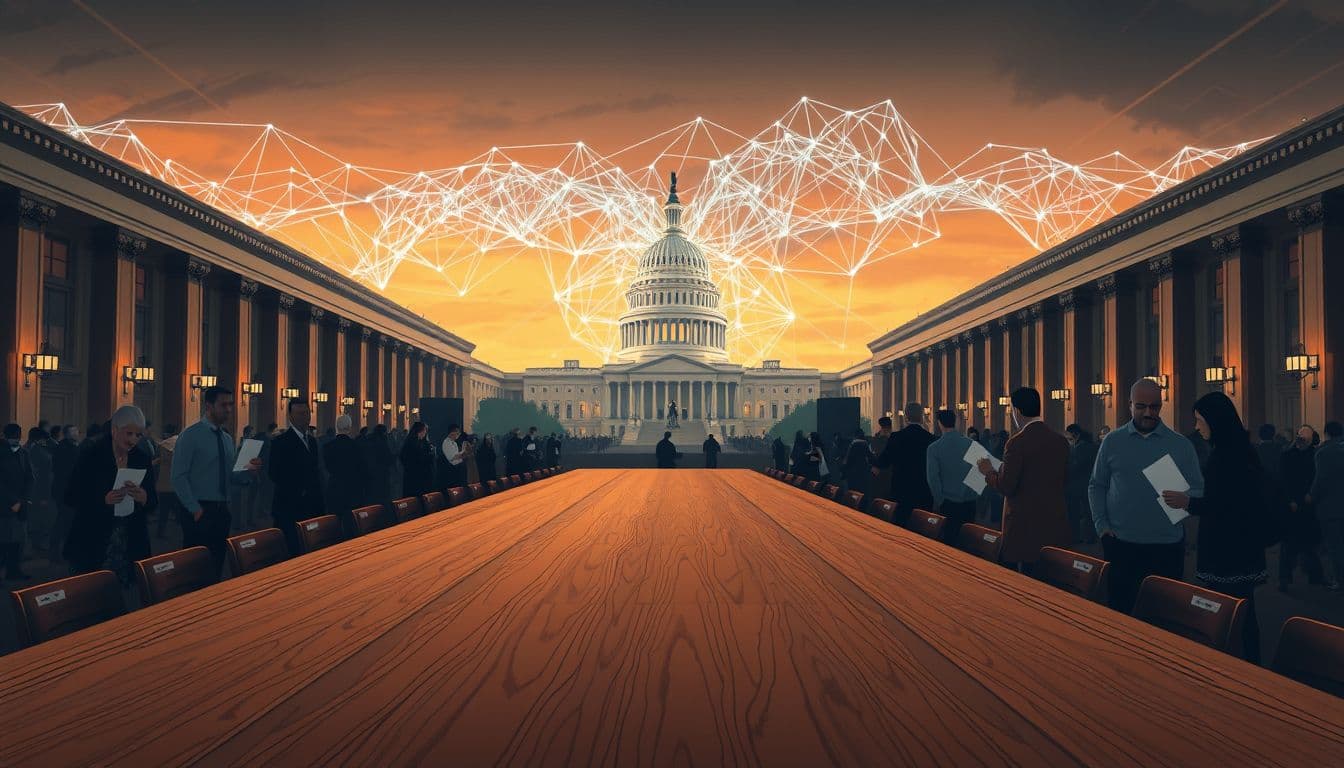
On November 4, 2026, Chris Lehane, OpenAI's chief global affairs officer, published a long essay with a blunt claim: the 2028 U.S. presidential race will be about AI. The story of OpenAI and the 2028 election sounds like American politics, yet it shows where AI policy is heading worldwide, and sooner or later that shapes how software companies build and sell AI products.
Why OpenAI calls 2028 "the AI election"
In the essay, published in OpenAI's global affairs newsletter, Lehane compares today with 1932, when industrialization upended daily life and millions of people felt they had lost control of their economic future. Franklin D. Roosevelt answered with the New Deal, a rewrite of the social contract. Lehane argues that 2028 candidates need a "third path": neither letting AI advance with no speed limits nor leaving the technology in the hands of a self-appointed elite.
He backs this with polling he says he has seen: 66% of voters support continued AI development, 53% of them want stronger safeguards and oversight, and 24% favor a pause. These figures come from OpenAI's side, so read them with appropriate caution.
The timing matters too. According to TechCrunch, the essay landed right after a surprise Democratic win in the midterms, driven by voter frustration over the cost of living. AI was not the dominant issue, but opposition to data centers became a cross-party concern in several races.
Five policy priorities, and what sits behind them
Lehane lays out five priorities, running from worker protections and education to AI safety and data center development. A few stand out:
- Tax and labor: incentives for workers to learn AI skills, easier access to capital for entrepreneurs, and new takes on employee ownership and profit sharing.
- Data centers: he acknowledges community worries but stresses construction jobs and local tax revenue, and warns that backing a moratorium could cost the U.S. its lead over China.
- Children and schools: age-appropriate protections, including around AI companions, while arguing against keeping AI out of classrooms.
- Safety: enforceable standards, independent evaluations, public oversight, and the ability to restrict AI systems or shut them down.
- Human control: consequential decisions should not be handed over entirely to machines.
Read closely, most proposals would encourage broader AI adoption and support the infrastructure that companies like OpenAI need to grow. That is TechCrunch's observation, not just ours.
Where experts push back
Kate Brennan, who leads AI and corporate power policy at the AI Now Institute, told TechCrunch the tone marks a shift from OpenAI's policy agenda last year, which centered on speeding up development and cutting regulatory barriers. She called the New Deal framing ahistorical at best, since it comes from a private company advocating policies that benefit itself.
The criticism comes down to a few points:
- The tax ideas are incentives, not binding rules that make companies share gains or pay for the cost of displacing workers.
- The claim that AI improves learning is treated as settled, while critics say it is unproven.
- OpenAI opposed California's SB 1047 safety bill in 2024 and last year argued for limiting state-level regulation, although it has since shifted on some positions.
TechCrunch reported that OpenAI did not respond to its request for more detail before publication.
What software teams and businesses should take away
You do not have to be in the U.S. to feel this. Debates over AI safety, independent evaluation, child protection and the electricity cost of data centers often become templates for rules elsewhere, and they eventually appear in the clauses large customers put in contracts.
For teams building AI products, three practical steps are worth starting early:
- Document how the system makes decisions. If "humans stay in control" becomes the norm, you need clear points for reviewers to intervene, plus logs for traceability.
- Prepare for independent evaluation. Test data, safety criteria and incident procedures should already exist in written form.
- Budget for infrastructure. Political pressure on data centers could push up compute prices and add requirements about where data is hosted.
This fits themes we have followed before, such as Anthropic's warning that AI may be nearing recursive self-improvement and Google letting schools switch off AI by default. Big players are all answering the same question: how far should AI be controlled?
An essay, not a policy
To be clear, this is an opinion piece from an AI company, not a bill or a binding commitment. Its value is as a signal that the industry is moving from "accelerate and remove barriers" toward the language of safety, jobs and public trust. Whether the words turn into action will show in the laws OpenAI supports or opposes over the next two years.
Conclusion
OpenAI is trying to frame the AI debate in U.S. politics very early, with a message balancing opportunity and safety, though analysts see it leaning toward corporate interests. For developers and businesses, the lesson is to build responsible AI now: transparent, under human control, and ready for evaluation.
If you are weighing how to bring AI into your product safely and in line with regulation, contact the Besoft team to talk through the right approach.
Sources
- TechCrunch, Rebecca Bellan, "OpenAI is already trying to shape the 2028 election," November 4, 2026: https://techcrunch.com/2026/11/04/openai-is-already-trying-to-shape-the-2028-election/
- Chris Lehane, "2028: The AI election," OpenAI Global Affairs, November 4, 2026: https://openaiglobalaffairs.substack.com/p/special-edition-2028-the-ai-election